


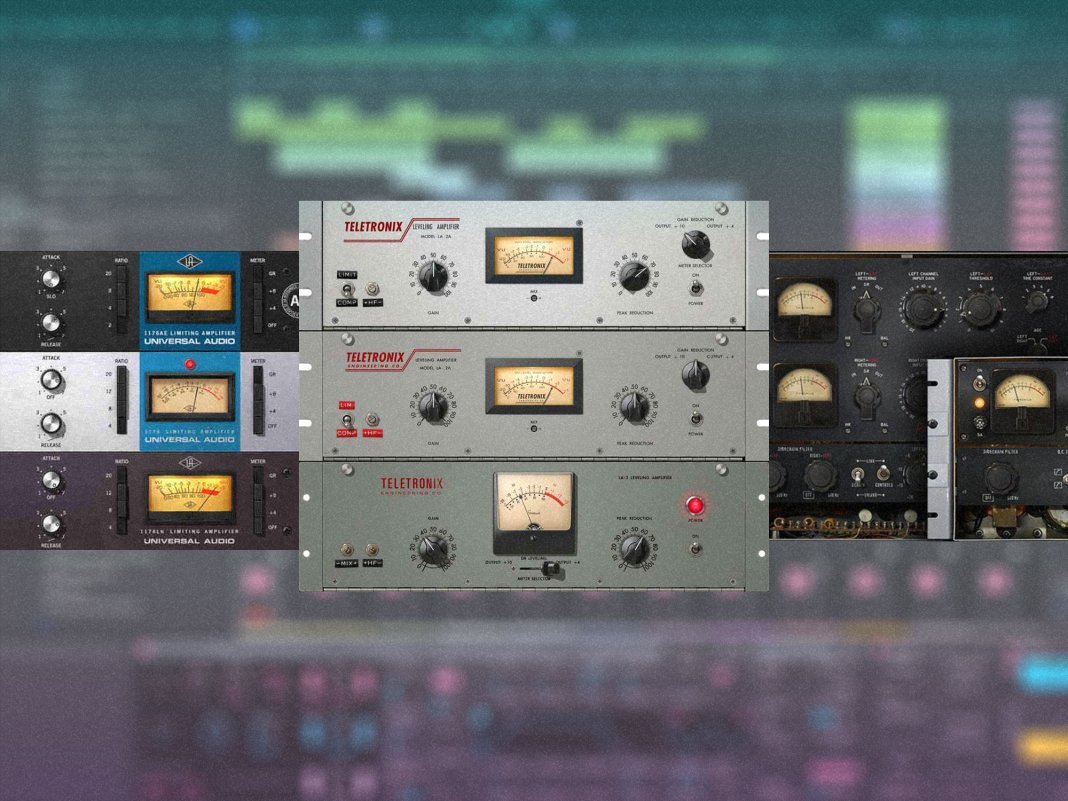
Compression is a process that reduces the dynamics of an audio signal. In this context, “dynamics” refers to the way volume changes within a passage of audio, both from moment to moment and across longer time spans.
The easiest way to conceptualise compression is as an automatic fader that turns down when the sound is loud, and returns to its original position when the sound becomes quieter.
READ MORE: Everything you need to know about audio compressors
What is a compressor used for in music?
Audio compression has many different applications, but its two principal uses are to smooth out excessive or unwanted volume fluctuations in a performance, and/or to make parts louder.
Imagine a vocal in which the performance swings between quiet and loud. Once embedded in a mix, the quiet passages may be hard to discern while the louder passages may be overpowering. You could deal with this by automating or manually riding the channel fader, but it’s much easier to hand the job over to a compressor.
When should I use compression?
During recording, a small amount of compression is useful for smoothing out volume fluctuations in a performance, and by reducing peaks we can add more gain and so capture a stronger signal overall.
During tracking and mixing, compression is used to further smooth out the dynamics of a performance if necessary, and to add sonic solidity and evenness to a part or submix. It’s also common to apply compression to the master mix buss with the aims of increasing the loudness of the mix, adding weight and solidity, and improving the sonic binding and coherence between instruments.
Finally, in mastering, compression is employed to add a final layer of solidity and cohesion, and to help with matching the audio’s dynamics to the requirements of the channels via which it will be distributed (for example, the requirements for Spotify are very different to those for CDs).
Related terms
Learn more music technology terms in our Glossary
Get the MusicTech newsletter
Get the latest news, reviews and tutorials to your inbox.