


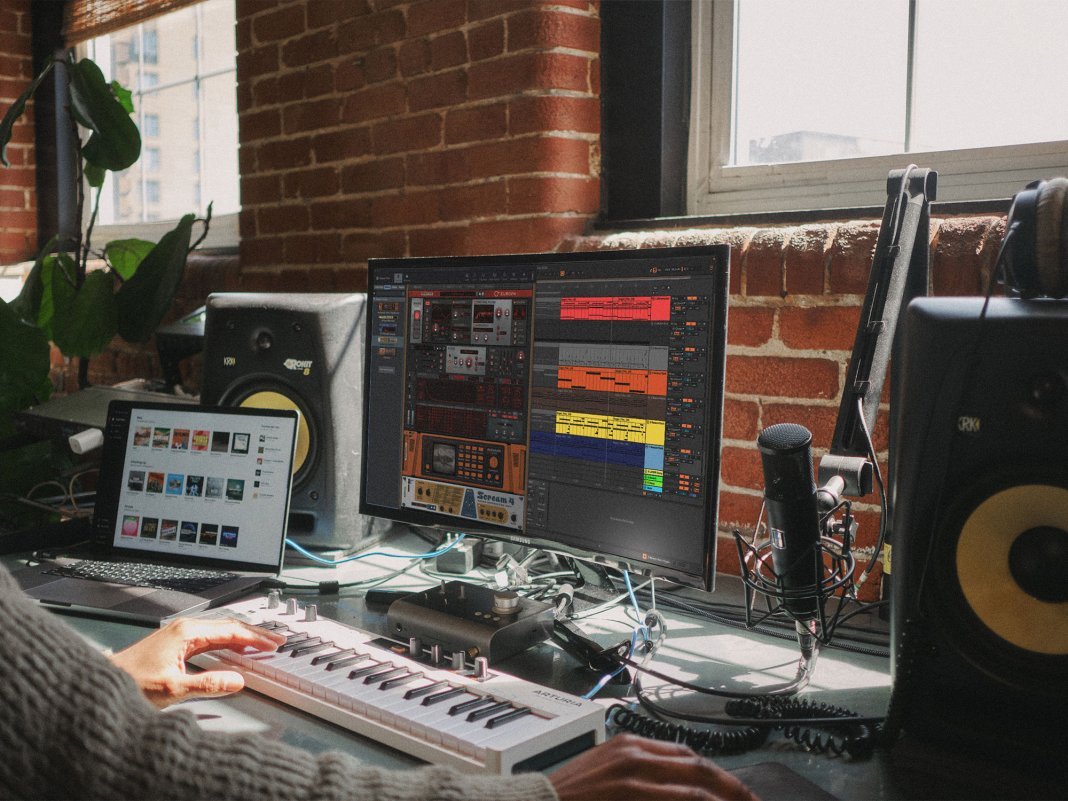
Ad feature with Reason Studios/LANDR
Reason has always felt like something of an outlier in the production world, largely thanks to its virtual hardware Rack. Hit the flip button, and you’ll discover patch points, CV connections, and a tangled spaghetti of animated cables, all ready to be rerouted as you please. This distinctive approach to music-making has earned Reason a dedicated following since its release in 2000.
Earlier this year, LANDR acquired Reason Studios, marking a new chapter for one of music production’s more idiosyncratic names.
For those yet to experience said idiosyncrasy, the recently launched Reason Free makes for an enticing introduction. The bundle puts 15 fully functional Reason devices – four instruments, five effects, and six utilities – inside the DAW you already use at zero cost, with no trials, expirations, watermarks, or strings attached.
Once installed, Reason Rack loads as a VST3, AU, or AAX plugin in a DAW, meaning there’s no need to abandon the workflow you already know. But Reason Free can also run as a slimmed-down 16-track version of the Reason DAW, complete with its hardware-inspired mixer that includes per-channel EQ, filtering, compression, and gating.
The Rack plugin comes in instrument and effect versions, depending if you want to generate sound or process incoming audio. I load the instrument version onto a MIDI track in my main DAW, and Reason’s familiar skeuomorphic rack cabinet appears, ready to be filled with devices.
Reason Free includes four instruments, but the flagship Europa Shapeshifting Synthesizer feels like the obvious place to begin. Powerful yet accessible, its three independent engines offer a unique combination of synthesis techniques including virtual analogue, wavetable, spectral, physical modelling, and FM.
I familiarise myself by touring the selection of 600 diverse presets. While wavetable synthesis often veers towards hard, glassy, or digital tones, I’m immediately struck by Europa’s organic character, especially evident in its soft, textural pad patches.
As I start to pull the patches apart, Europa’s depth becomes clear. There’s a vast range of wavetables, multiple ways to morph and manipulate them, plus a flexible modulation system plus semi-modular effects section. It’s a sound designer’s dream, and Europa alone makes Reason Free worth a download.

I begin to explore the effects bundled with Reason Free, starting with the Scream 4 Distortion. Initially aggressive and unwieldy, it can be tamed, but I’m more interested in its less conventional algorithms – Feedback, Warp, and Modulate – that make my patch far less predictable. By now I’m firmly in the Reason mindset, so I flip the rack and start connecting cables.
Reason Free includes the Pulsar Dual LFO utility for deeper modulation duties, but Europa can also route its own internal mod sources to four CV outputs. I send two of its LFOs and the Key source into Scream 4’s parameters, creating rhythmic distortion that responds to the notes I play.
Not every connection produces something you’ll want to keep, but after a while it’s easy to unearth something characterful enough to build an entire track around.
Maybe this is why Reason endures. Its workflow encourages me to drop a few things in and think of an interesting way to make them interact. I’m nudged in a more playful direction; the Rack’s immediacy compels me to design sounds with more depth and movement than usual, but doing so feels instant, exciting, and remarkably addictive.
There are three other instruments to explore in Reason Free. The ID8 Songwriter’s Toolbox provides ready-to-go sounds akin to a ROMpler, while the Monotone Bass Synthesizer handles low end and leads. Finally, Kong Drum Designer covers the rhythm section, with various sample- and synth-based approaches to creating kits.

Again, Reason’s patching makes these devices immensely compelling. I plug a Pulsar Dual LFO module into Kong’s gate inputs, creating meditative, off-kilter drum loops devoid of quantisation and predictability. Pulsar can even output its oscillators as audio, opening the door to more experimental patches built from the basic ingredients of synthesis.
Another effect within Reason Free is the Audiomatic Retro Transformer, with one-knob control that instantly places your sound within a new era or space. There are 16 models to choose from; more subtle options like Tape, VHS, or Hi-Fi are perfect for adding the finishing touches to a patch, while settings like mp3, Gadget, and Cracked can fully degrade your signal into mulch when pushed. Users also get lush convolution-powered reverb via the RV7000 mkII, The Echo for classic, dubby tape delay reminiscent of the fabled RE-201, and the MClass Maximizer for enhancing dynamics.
In any case, Reason Free has captured my imagination. There’s a tremendous amount of possibility within this modest collection of devices, and I could sink hours exploring the many thousands of ways to patch them together.
Reason Free will undoubtedly give some users a taste for more. That’s where Reason’s paid options come in.
A Reason 14 perpetual licence is currently £299 and includes the DAW and plugin, or you can buy the plugin only for £199. With both, users get 68 Reason Rack Devices and over 50,000 samples, loops, and patches.
Subscription plans are available too, which include all 93 Reason Rack Devices plus new sound packs added weekly. The plugin-only version costs £8.25/month, while Reason+ for £10.14/month includes the DAW, Rack plugin, and a variety of LANDR tools including unlimited AI stem separation, AI mastering, and distribution.
Download Reason Free today to get 15 legendary devices in your DAW, forever.

James is a freelance writer for MusicTech. You’ll often find him pushing plugins to their limits, skimming through the latest sample packs, or obsessively watching Rig Rundowns. With a background in live music, he also loves finding elegant solutions to complex problems — especially when it comes to gear.