


In the depths of lockdown, when Jacqueline Springer read the Victoria & Albert Museum’s advert for the role of Curator Africa & Diaspora: Performance, it struck her as a “chorus of realisation.” For the London-raised creative, whose illustrious career spans music journalism and broadcasting, lecturing, programming and event coordination, the role felt like a rare alignment of her academic study and curatorial practice, bringing those strands together within a single space.
Speaking to Billboard U.K. over video call, Springer recalls spending “over a fortnight” on the application as she revisited the lessons she has gained from over a decade spent teaching about representation and sociological theories with music media. The successful candidate would be given the space to rethink how narratives surrounding Africa and its diaspora are collected, interpreted, and staged within one of the world’s most influential cultural institutions. Energized by the possibilities this would entail, Springer knew she had to take the chance.
Five years on, we speak mere weeks before the April 18 opening of The Music Is Black: A British Story, the inaugural exhibition at V&A East – the V&A Museum’s new site in Stratford, east London, an area considered the birthplace of grime. In originating her role with the V&A, Springer has been pivotal to the development of this new immersive exhibition, which frames Black British music as a central force in shaping the U.K.’s wider cultural identity.
“Some people may think that this exhibition is just about the history of Black British music, which it isn’t,” she explains. “Their mind may go straight to the mid-1970s’, or if they like jungle and drum ‘n’ bass, the mid-’00s. But you have to travel through the preceding histories to get there, which are complex. They overlap. They show inhumanity; they show inventiveness. You have to strip it all back in order to get that messaging across.”
Encompassing 125 years of history, The Music Is Black: A British Story maps the impact of British colonialism and how migration has influenced the cross-cultural richness of modern music. It houses over 220 objects, drawing on photographs, paintings, prints, stage outfits and more, honouring trailblazers like Janet Kay, Dame Shirley Bassey and Steel Pulse alongside contemporary voices such as Little Simz and Sampha. It also examines how the sounds and styles forged within Black British music have been reinterpreted by acts like The Rolling Stones and The Beatles, moving through genres from reggae and lovers rock to blues and Afrobeats.
In reframing that history on such a scale, the exhibition seeks to redefine where that musical legacy begins, and who it belongs to. Springer describes how she spent years travelling across the country to gather her research, which included discussions with the family of the late Charlie Watts – the Rolling Stones drummer was an avowed jazz fan and record collector – and a trip to Birmingham to examine the Gun Quarter’s historical role in the arms trade and its links to the transatlantic slave trade.
With its grand opening approaching, Springer discusses her research process for the exhibition, how the industry has responded, and what it means to be engaging new audiences with the work of an institution as iconic as the V&A.
When you began working on this project a few years ago, how did you first envision the exhibition looking? And how did that change over time?
It has changed over time, but the ‘rail tracks’ of it were always quite fixed. We begin in 1900, when the age of invention, which had really invigorated the previous century, starts to shift rather than stop. It moves into mass media: print remains dominant, then radio arrives, then television. Cinema becomes a popular form, but it’s also used by news, especially during the world wars, and that intersection has always interested me.
My work in academia, over ten years across Syracuse, Westminster, and Fordham, has consistently been about media: how it treats people, what it communicates, and how representation is constructed. How do you depict someone who is northern, or gay, or poor? These building blocks come from pre-existing histories, shaped by a country’s wealth, its sense of itself, and how it’s seen by others. That then filters into society – how people are ranked, how they rank others – and how those views are reinforced and exploited through print, cinema, radio and broadcast.
That thinking feeds directly into the exhibition. It’s about how we view other cultures, languages and musical forms. Jazz, for instance, was initially dismissed as unserious or disruptive; blues was seen as lesser; gospel emerges from a Bible imposed on enslaved people. These judgments are tied to race, class and power, and to how “acceptable” culture is defined.
So the process has been about tidying that up – making a big, complex idea digestible. It’s moved from something quite bold and conceptual into something people can actually walk through, listen to, and understand. As audiences engage with it – through music and other senses – it becomes a way of deepening their understanding of musicality and the African diaspora. And that’s come through collaboration, both within the V&A and with external partners.

Adrian Boot
To what extent is this exhibition shaped by trust and your relationships, as opposed to formal research?
By getting the role, you’re entrusted to know what you’re doing, and an interview demands that there’s a test, in many respects, to see if you’re best for the job. I come from a background in print, music journalism, broadcast journalism, but also lecturing to university students, and also independently curating events. So I already spoke to people – people who are interested in the topic, but not necessarily how it’s presented, until they see elements that they can understand.
And that’s definitely the case with students. You know, I used to teach for three hours at a time, so I always activated or interspersed my lectures with content, empirical evidence that they could see. If we’re talking about the World Wars, they had newsprint that they could actually see how the enemy was produced and represented.
In relation to the research that I was going to undertake for the exhibition, that same approach applies: making sure that what I present is grounded, visible, and something people can engage with and understand.
How do you present underground scenes that may have been preserved through community memory rather than in art or writing?
I have to say, you’re wrong. People keep things. I just think that the performer populace and the fandom [of certain scenes], have just not been approached to actually say, “Can we share this?” You know, we’ve now got the Museum of Youth Culture [in London], and you’ve got young people throwing their material at them. But you’ve also got some people who are institutionally-averse who may say, “How are you going to look after my things?” And, also the vast majority of artists that were approached never thought the V&A would ask them.
Artists retain their own experiences, and many of them have retained a lot of their personal ephemera. [This process] was about tailoring that ephemera in a way that it looked elegant. Rather than asking for specific objects, I asked artists to consider [their journeys], and then I came back to them. My approach was to ask them if they could identify an item that actually testified to their ability to make music. So it’s not necessarily an instrument, it could be anything – and then their explanation would help me work out where that item would knit with another.
One of the things that was so surprising to me was that the vast majority of artists, when I asked them that question, they said, “I’ve got some sales discs” – that’s an institutional calculation of your commercial value, that’s a response to the art you make. We have Joan Armatrading’s handwritten chord book. We have a handwritten musical score by an opera singer called Peter Brockway, it’s beautiful material. We’ve got [singer] Junior Giscombe’s glasses; he was encouraged to take them off so that he could break America. You’ve got some of those big moments, but you’ve also got these beautiful moments that show how people actually work and mobilize together.
Daniel Pollitt
What did it take to build and deepen trust with those prospective donors who were initially “institutionally averse”?
Firstly, I’ll tell you that musicians keep secrets; I would trust them with a secret even more than some of my good friends! [When speaking to artists], I would reaffirm the reputation of the V&A, and then let them know how precious this exhibition is to me. I mean, the V&A recently had an exhibition on Fabergé eggs [Fabergé in London: Romance to Revolution, 2022] – they’re so expensive! There were security guards in situ alongside the objects, not just in the room.
But whether it’s a Fabergé egg or [Lovers rock artist] Janet Kay’s stage clothing, these are classed as museum objects. We don’t see them just as a dress or a record disc, they’re covered by Government Indemnity insurance; they are precious objects, and they allow us to tell a story to the public. Formal loan agreements are signed and there’s a robust process to it.
Were there conversations with artists that shifted your understanding of their work?
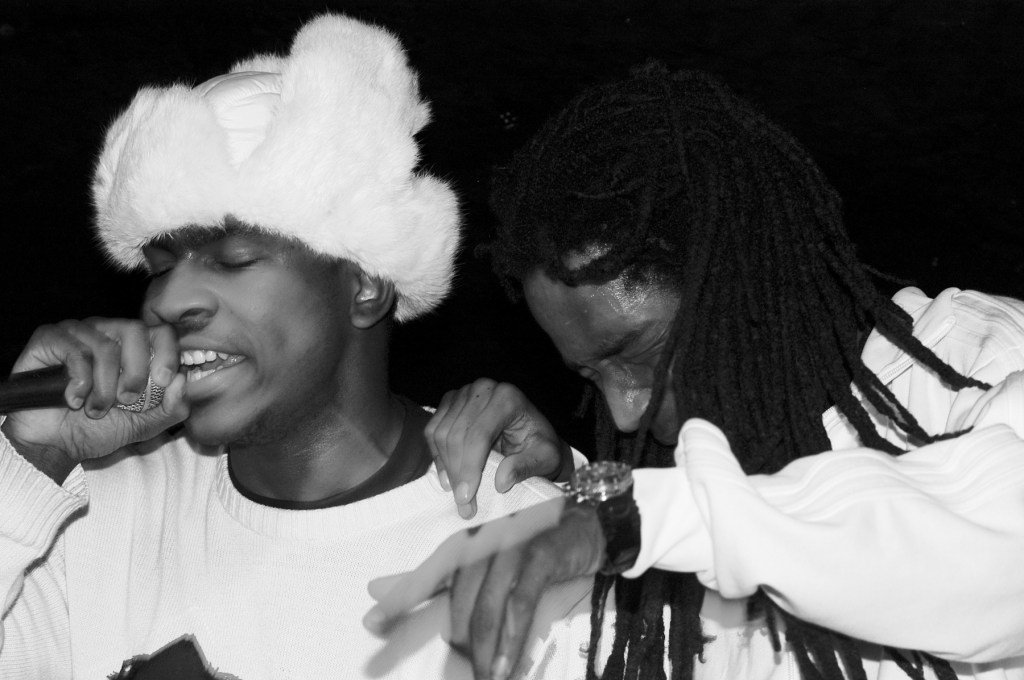
I think JME is a quiet storm. You know, he is often referred to as “Skepta’s brother” or the co-founder of Boy Better Know, but he knows his own value. I met him at an event through my best friend, who works for ITV and reads the news. So I said, “JME is over there, he looks like he doesn’t want to be disturbed. Can you take your famous face over there to reassure him?”
That warmed him up a little bit; he’s a reluctant participant when it comes to being a celebrity, but we worked to get his guard down. I told him about the exhibition and he said, “Well, you can have a Super Nintendo. I used to make music on it; that’s how you make beats if you don’t have any money but you’ve got an inventive mind.” When you look back over the course of the exhibition – the creation of the wax cylinder all the way to PinkPantheress deciding through TikTok that she’s going to make short songs – you think about the inventiveness of people, and how much of it has born through through socio-economics.
Pirate radio was born of a desire for musical autonomy. The national broadcaster says, “We’re not playing jazz” in the early 1920s; “We’re not playing rock ‘n’ roll” in the early 1950s. So you listen to pirate radio, and then by the 1970s, [Dread Broadcasting Corporation] DBC and others start to broadcast illegally, because the music is still there. So you constantly find the way in this exhibition through which Black people have insisted on having their rights.
How do you feel the exhibition will set a precedent for what V&A East represents going forward?
This is a landmark exhibition because of its breadth. But it has to attract a younger audience, many of whom feel that unless they go with school, they don’t go to museums. They see museums as a place where they’re forced to go on a day trip when they probably want to go somewhere else – we’ve all been there, where the structure of a school trip can take the delight out of things and feel like a chore.
Talking to young people and showing them how self-expression is an extension of your identity, that it is just like the words that you type into your phone, is important; your creative calling can be your absolute joy. You have to open the door and tell them, “This museum is yours forever.” The exhibition falls into that, because that’s what music is – it’s art and it’s forever.
In many respects, the exhibition complements the overarching ambitions of this museum. It will become a beautiful memory after nine months, but hopefully, like a good lecture at university or school, it lives on with you like a little nugget of inspiration.
Beyond visitor numbers or positive press coverage, what would success look like for this exhibition?
I just want people to leave the exhibition, if possible, thinking with awe. People who make music walk among you; you may be sat next to them on the bus, they may be sat opposite you on the train. Think how incredible it is to live under the same sky as somebody who makes music that makes you feel better about yourself.