


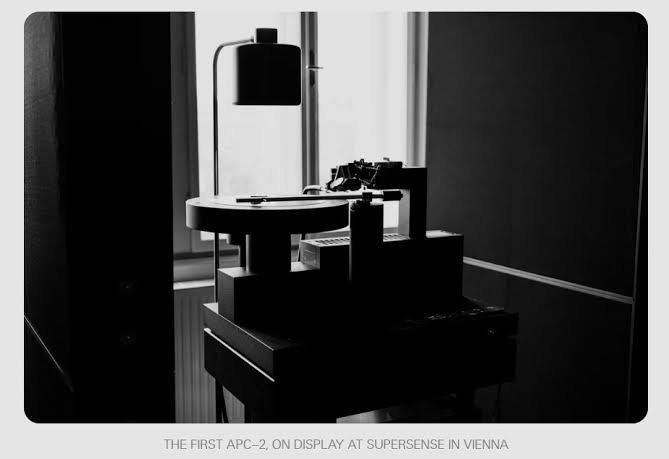
Not since the Vestax VRX-2000 has an off the shelf record cutting lathe felt like a genuine shift in who gets to make a record. Teenage Engineering’s new APC-2, built with Viennese analogue specialists SUPERSENSE, is the first machine in more than two decades that looks capable of picking up where Vestax left off, and it arrives with rather more engineering behind it.
The context matters. Vinyl cutting has never really recovered from the industry’s decision, somewhere in the 1980s, that the format was finished. The lathes stopped being made. What survived were Neumann VMS70 and VMS80 units, plus a scattering of Scully and Presto machines, all of them restored, re-restored and nursed along by a shrinking number of engineers who understand them. Teenage Engineering makes the point plainly: the pool of people who can maintain these machines is drying up, and the cutting head remains the single hardest component to reproduce. That scarcity is why a dubplate costs what it costs, and why cutting has stayed a closed shop.


The APC-2 addresses that directly. Rather than attempt a clean room clone of a Neumann head, Teenage Engineering has gone to Swiss inventor Flo Kaufmann, whose DIALBA stereo feedback cutting heads have quietly built a reputation in cutting circles for matching and in some cases bettering the originals. Kaufmann’s head sits at the centre of a system that includes a direct drive motor on a precision polished tungsten shaft, variable pitch control, an integrated power amplifier with feedback and RIAA encoding, temperature controlled heating for the stylus, a vacuum system handling both hold down and swarf removal, and an RIAA monitoring amplifier with its own custom tonearm for playback. Wow and flutter is quoted at under 0.01% WRMS against a reference clock accurate to 1.5 ppm.
The specification that will interest producers most is the automation. Pitch control can be driven directly from a DAW, which means variable groove spacing, locked grooves and specialty cuts become programmable rather than a matter of a skilled operator’s hands and ears. The whole machine can be controlled remotely over Ethernet or wifi, and it runs from a single IEC connector. Anyone who has spent time in a cutting room, watching an engineer ride pitch by hand while the lacquer turns, will recognise how substantial that change is.
It is not a desktop unit. The APC-2 is powder coated aluminium on granite, 1300 x 600 x 400 mm, and Teenage Engineering lists it at 140kg, though early coverage from MusicTech has cited 104kg, so the shipping weight is worth confirming before anyone measures a doorway. Distribution is exclusively through SUPERSENSE, only a limited number of machines have been built so far, and there is no public price. You email them. That is not a soft launch tactic so much as an acknowledgement that a machine like this needs to be placed carefully and supported properly.


Teenage Engineering’s own framing is that the lathe has historically functioned as a gatekeeper, and that cutting a record has meant securing access, approval, a label and a budget. SUPERSENSE talk about small editions, records cut on demand, unusual shapes and sizes, and live performances turned into a physical object in the same room, in the same hour. Neither company is claiming to compete with pressing plants, and they are right not to. Nothing here changes the economics of a 500 unit run.
What it could change is the middle ground. Underground electronic music has always had a working relationship with the dubplate, from Jamaican sound system culture through jungle, garage and the test press circuit that still sustains a good deal of the house and techno underground. That relationship has been mediated by a handful of cutting houses in London, Berlin and a few other cities, with waiting lists to match. If the APC-2 puts credible cutting capability into independent studios, small labels and record shops, the effect is less about mass production and more about turnaround, iteration and the ability to hear an idea on vinyl before committing to it.
The caveats are the obvious ones. Cutting is a craft, and a well specified machine does not make an engineer. Lacquer supply remains fragile. And an unpriced, made to order product available only by email is a long way from being off the shelf in any meaningful sense yet.
Still, this is the most serious attempt at a modern production lathe in a generation, from a company that has form in building things nobody asked for and then watching them become standard equipment. The Vestax comparison is apt, but the VRX-2000 was a curiosity that arrived slightly ahead of the vinyl revival. The APC-2 arrives in the middle of one.
Find out more at Teenage Engineering
Related
Discover more from Decoded Magazine
Subscribe to get the latest posts sent to your email.